 I haven't done any photography since spring. But when I went outside a couple of days ago, this Swallowtail was feeding from our Mexican Bird of Paradise. I ran inside and grabbed my camera. Got this "point and shoot" - no time to focus - just before it flew away.
Showing posts with label butterfly. Show all posts
Showing posts with label butterfly. Show all posts
Tuesday, September 30, 2008
Pipevine Swallowtail
I haven't done any photography since spring. But when I went outside a couple of days ago, this Swallowtail was feeding from our Mexican Bird of Paradise. I ran inside and grabbed my camera. Got this "point and shoot" - no time to focus - just before it flew away.


Tuesday, November 21, 2006
Painted Lady Butterfly
This Painted Lady butterfly was feeding on a creeping lantana in my patio.
 The Painted Lady (Vanessa Cardui) is one of the most wide ranging butterflies in the world. It occurs in North and South America, Europe, Asia and Africa.
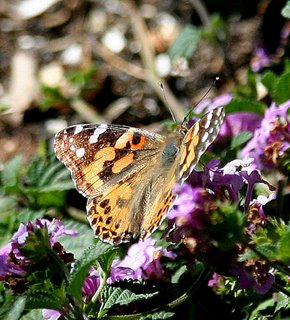 See Painted Lady Butterfly [t.beth of Firefly Forest] and Painted Lady (Vanessa Cardui) [AÖrstan of Snail's Tales] for more information about this butterfly and how to distinguish it from the American Lady butterfly.

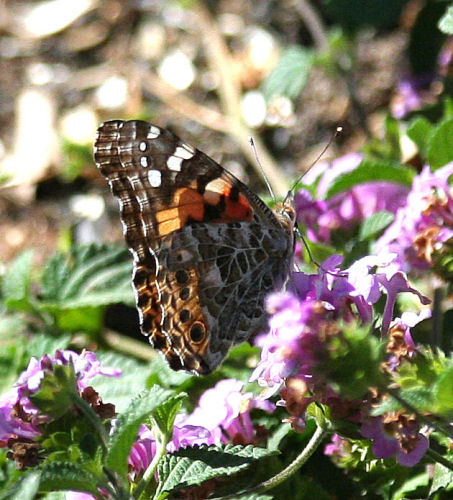 The Painted Lady (Vanessa Cardui) is one of the most wide ranging butterflies in the world. It occurs in North and South America, Europe, Asia and Africa.
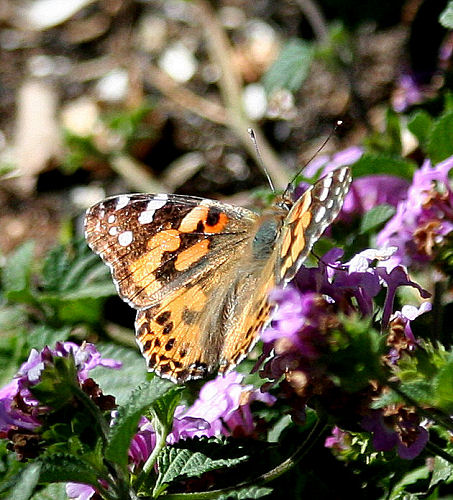 See Painted Lady Butterfly [t.beth of Firefly Forest] and Painted Lady (Vanessa Cardui) [AÖrstan of Snail's Tales] for more information about this butterfly and how to distinguish it from the American Lady butterfly.
Monday, October 30, 2006
Mystery Butterfly
Unfortunately, I wasn't able to attend the second (and final) butterfly photography class for this year at the Tucson Botanical Gardens Butterfly Magic display. I hope to get a shoot in some time soon while they still have Asian butterflies on display, but I won't be able to take in a tripod or monopod when the exhibit is open to the general public.
I took these photos in the first class session. I don't know what this butterfly is. (Any help with identification will be gratefully received.)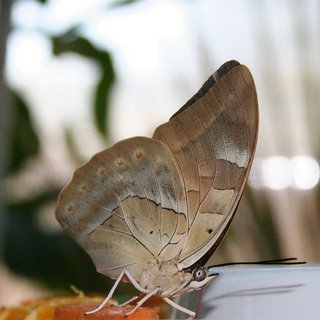 Normally, I don't like to show butterflies on feeders, but this one captivated me with its long proboscis savouring a piece of orange.
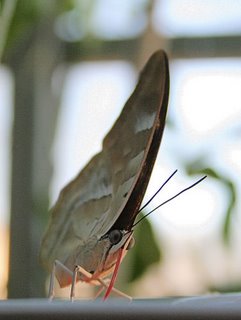 The proboscis is a tubular sucking organ that enables a butterfly to extract nectar. When not being used, the proboscis is rolled up out of the way.
I took these photos in the first class session. I don't know what this butterfly is. (Any help with identification will be gratefully received.)
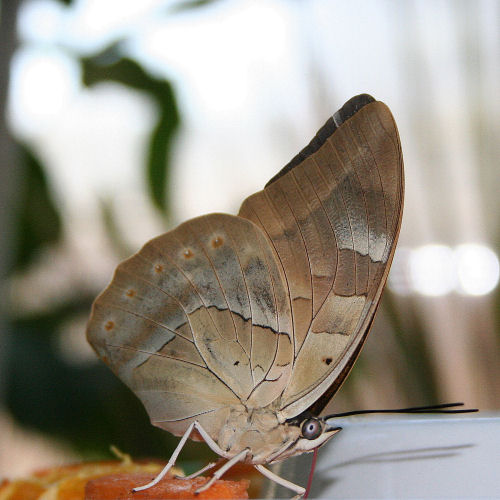 Normally, I don't like to show butterflies on feeders, but this one captivated me with its long proboscis savouring a piece of orange.
 The proboscis is a tubular sucking organ that enables a butterfly to extract nectar. When not being used, the proboscis is rolled up out of the way.
Monday, October 23, 2006
Giant Swallowtail Butterfly photos
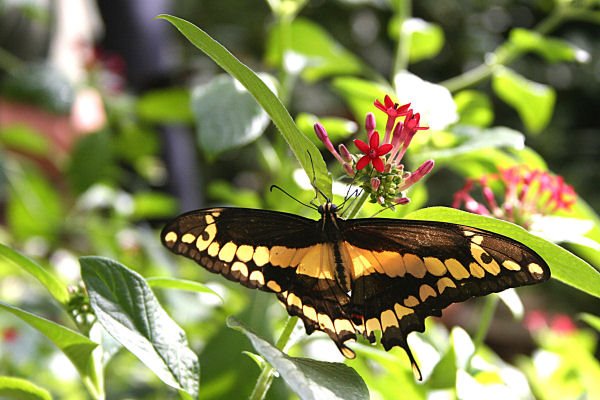 Here are a couple of photos I took of Giant Swallowtail (Papilio cresphontes) butterflies at last year's Butterfly Magic exhibit at the Tucson Botanical Gardens. I love the striking difference between the dorsal and ventral colouring. I had no idea when I first processed these photos that it was the same butterfly.
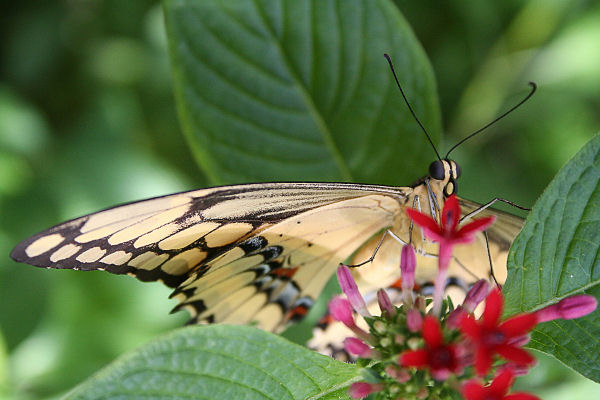 The Giant Swallowtail is the largest butterfly occurring in the United States. "The adult butterfly is quite large, with a wingspan of up to 7.4 cm for females. The wings have a striking and easily recognizeable black and yellow pattern." Its diet includes milkweed, goldenrod, Japanese honeysuckle, Lantana and morning glory. "... The caterpillar is known as the Orange Dog because it is a common pest for citrus farmers. The caterpillar has two effective adaptations for defense against birds. The first is a reddish osmeterium that is extended when the insect is bothered. The pheromones are foul-smelling and are thought to deter birds. Secondly, the coloration of the larva makes it appear to be an inconspicuous bird dropping." Wikipedia
Sunday, October 22, 2006
Owl Butterfly photo
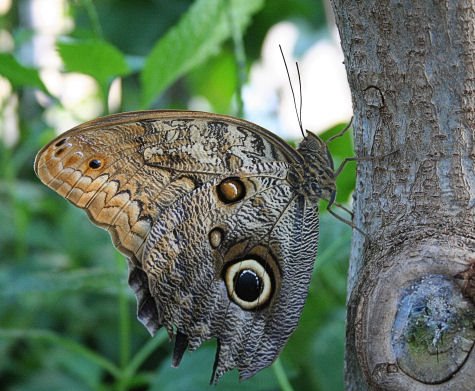 Owl butterfly (Caligo memnon)
 Aperture priority, auto exposure, 1/25 sec., f/5.6, 55.0 mm., ISO 800
This is one of the very few successful photos I took last Wednesday during a class on photographing butterflies at the Butterfly Magic Exhibit at the Tucson Botanical Gardens. (Another photo of a Paper Kite on orchid buds is posted in Good Planets Are Hard to Find 10/21 on our good friends' The Dharma Bums blog.)
This is a repeat of a class I took at the botanical gardens last year. That class was scheduled so that we were in the greenhouse from 10:45 a.m. to noon. The light was fantastic and 95% of my shots were in focus and properly exposed. This year, we're in the greenhouse from 3:45 to 5:00 p.m. I didn't realize what a difference that would make. The light levels were poor throughout most of the area and I had to shoot at ISO 800 or even ISO 1600. I found it very difficult to focus. Last year's instructor suggested that in photographing butterflies, you should try to focus on the eyes. Most of the time I couldn't see well enough to do that. I had the lens wide open, but even then the shutter speeds were so slow that almost all my handheld shots suffered from camera motion. (I started with my 70-300 mm IS lens, thinking that the image stabilizer would help, but I couldn't get far enough away from the butterflies, so I switched to the kit lens that came with my camera - 18-55 mm., which isn't IS. This is the lens I used last year with quite a bit of success.)
I have one more session on Wednesday. I'm going to take my 100 mm. macro lens and a monopod. (I'd already planned to do this for the second session, since I haven't worked with macro very much.) A tripod doesn't really work with these butterflies because although they will sit still for a little bit, they're likely to fly off before everything's adjusted. I've ordered an external flash that's designed for the macro lens. If it arrives in time, I'll use it where appropriate. That will be another learning experience in itself.
This is a repeat of a class I took at the botanical gardens last year. That class was scheduled so that we were in the greenhouse from 10:45 a.m. to noon. The light was fantastic and 95% of my shots were in focus and properly exposed. This year, we're in the greenhouse from 3:45 to 5:00 p.m. I didn't realize what a difference that would make. The light levels were poor throughout most of the area and I had to shoot at ISO 800 or even ISO 1600. I found it very difficult to focus. Last year's instructor suggested that in photographing butterflies, you should try to focus on the eyes. Most of the time I couldn't see well enough to do that. I had the lens wide open, but even then the shutter speeds were so slow that almost all my handheld shots suffered from camera motion. (I started with my 70-300 mm IS lens, thinking that the image stabilizer would help, but I couldn't get far enough away from the butterflies, so I switched to the kit lens that came with my camera - 18-55 mm., which isn't IS. This is the lens I used last year with quite a bit of success.)
I have one more session on Wednesday. I'm going to take my 100 mm. macro lens and a monopod. (I'd already planned to do this for the second session, since I haven't worked with macro very much.) A tripod doesn't really work with these butterflies because although they will sit still for a little bit, they're likely to fly off before everything's adjusted. I've ordered an external flash that's designed for the macro lens. If it arrives in time, I'll use it where appropriate. That will be another learning experience in itself.
Saturday, October 07, 2006
Western Pygmy Blue Butterfly
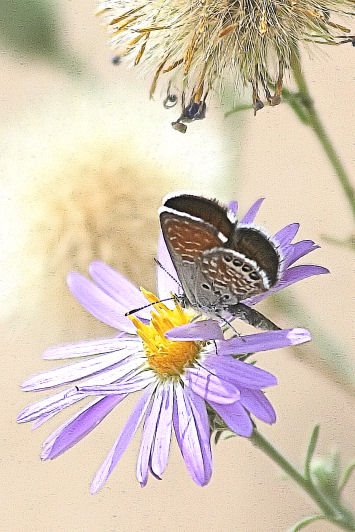 When I was out looking at the Hoary Tansy Asters that have sprung up in the old play yard after the monsoon rains, I noticed an extremely tiny butterfly flitting around one of the lavender flowers fairly low to the ground. It circled the plant several times, alighting on the flower for a few seconds each time. I managed to get some photos.
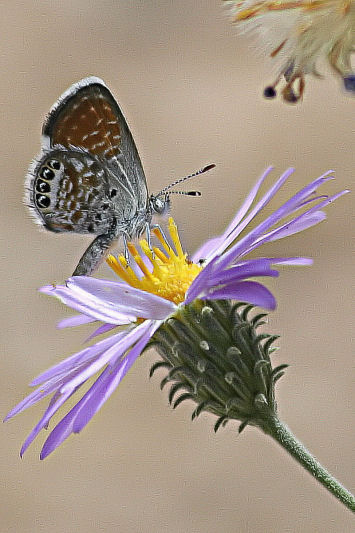 It took me quite a while to find this butterfly in the butterfly guide, but I was able to identify it by the distinctive spots on the hindwing and the long body. It's a Western Pygmy Blue (Brephidium exilis). Believed to be the smallest butterfly in North America, it averages 15 to 19 mm. in length. I measured the flower across its full diameter - 25 mm., so you can get some idea of the scale of this little creature. There doesn't seem to be much blue on this particular butterfly, which may indicate that its a female.
[Several web sites state that the Western Pygmy Blue butterfly is the smallest in the world. However, on December 2005 its alleged status was supplanted by the discovery of the even smaller Sinai Baton Blue butterfly. The Sinai Baton Blue butterfly lives only on mountainside patches of wild thyme in an arid corner of the Sinai Peninsula in Egypt called Saint Katherine's Protectorate. This tiny butterfly has been the subject of studies of how vulnerable animals will go extinct in the face of rising temperatures.]
Tuesday, September 12, 2006
What are these butterflies?
 A good friend gave me Butterflies through Binoculars: The West (Jeffrey Glassberg) for my birthday. We had just been to the Tohono Chul greenhouse and I was marvelling at the tiny little butterflies (she said they were Blues) fluttering around the desert plants. After I perused the book, I realized how much more difficult it was going to be to identify butterflies than to identify birds. So many butterflies look alike.
Last week I photographed some butterflies on our Red Bird of Paradise. The Sulphurs were large and easy to identify, although they didn't stay still for very long.
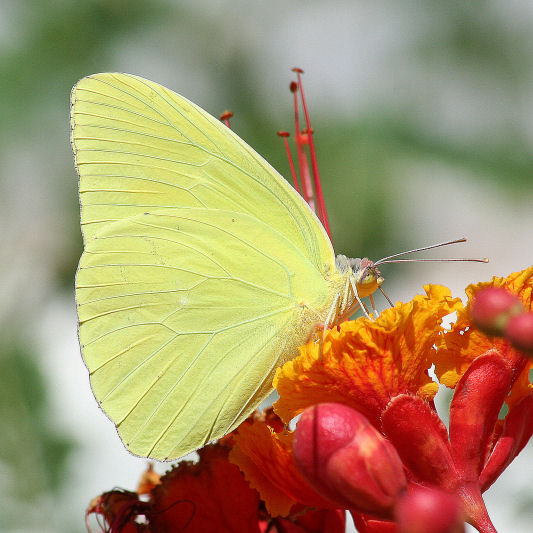 Cloudless Sulphur - male
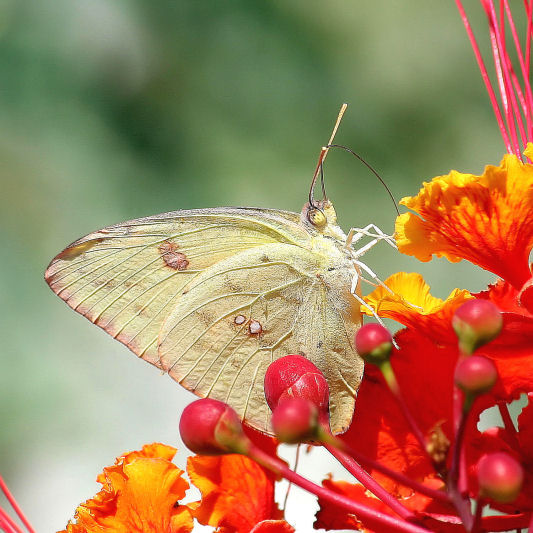 Cloudless Sulphur - female
We've had swarms of sulphurs in the neighbourhood lately. We drive very slowly so they don't get crushed on the windshield.
The other butterflies were tiny. Using my Field Guide, I tried to guess what they are, but I wasn't at all sure of any of them.
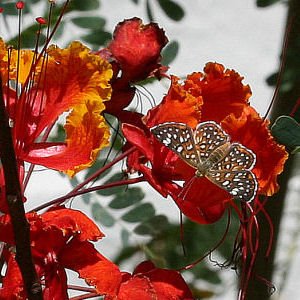 Palmer's Metalmark
(Apodemia palmeri)
 Ceraunus Blue
(Hemiargus ceraunus)
 American Snout
(Libytheana carinenta)
Thanks to t. beth of Firefly Forest for the identification of the American Snout: "They can be recognized by their long 'snouts'." and also for confirming my guesses and sending me the reference web pages for the Palmer's Metalmark and the Ceraunus Blue.
Subscribe to:
Posts (Atom)

