
I think these Northern Pintails were the most handsome birds at Agua Caliente Park last week. 

I think these Northern Pintails were the most handsome birds at Agua Caliente Park last week. 


According to the Cornell Ornithology Lab's All About Birds web site, [the Ring-necked Duck] is the most common diving duck to be found on small ponds in migration. It is more easily recognized by the bold white ring around its bill than the chestnut collar for which it is named. If you enlarge the bottom photo (double-click on it), you can see the chestnut ring. 

I spotted this cormorant in Agua Caliente Park last March. A warm spring feeds the three ponds in this park.
I looked through all the water fowl pictures in Sibley and Peterson, and I couldn't figure out what this duck is. I did find a clue in Peterson, which led me to look up "domestic mallard" in google images. This led me to the 10,000 Birds blog. Charlie wrote about "Manky Mallards," and has photographs of mallards very similar to this bird. Based on his article, I'm concluding that this is a feral male mallard. (Please chime in if you agree/disagree.)

CORRECTION: I originally posted this as "Snowy Egret," which is what a friend told me it was. However, the Cornell's All About Birds indicates that the Snowy Egret has a black beak and yellow feet, whereas the Great Egret has a yellow beak and black legs and feet. Since there is already a reference to this post on another blog, I thought I should put in this correction.
I've written about Roadrunners before. Here's a photo of one who came into our patio last week. It's only through enlarged photos that I've been able to see some of the colours in the roadrunner's plumage. (Click on the photo to see it full size. It's worth it!)
Sparrow; Gilded Flicker"Like the Northern Flicker, the Gilded Flicker is a medium-large, conspicuous bird, often seen on the ground. Flickers have brown backs with black, horizontal barring. The breast features a large, black crescent and the undersides are speckled. Gilded Flicker compares with the subspecies of Northern Flicker in several ways: Like the Red-shafted subspecies, Gilded Flicker has a red malar stripe, gray throat, and gray ear-coverts. These are in contrast to Yellow-shafted, which has a black malar stripe, tan throat, and tan ear-coverts. Gilded Flicker, however, differs from Red-shafted in having a yellowish crown (hence the name "Gilded"), and yellow shafts on the primaries. Gilded Flicker is slightly smaller than both Northern Flicker subspecies, and the background color of the underside is whitish, instead of tan."
A hot July morning in 1982. We were in
It was first light, but we could already feel the oncoming heat and humidity that would make walking almost unbearable after about 6:30 a.m. We set off along the road and found ourselves surrounded by cycling townsfolk balancing two, three or more bamboo bird cages on their bicycles. We reached the crest of the hill and discovered a beautiful path along the top of a steep wooded ravine. The villagers hung their bird cages on the lower branches of the trees and began their Tai Chi routines. As we walked along, many of the villagers stared at us. Most of the men had little or no facial hair, but an elderly gentleman, looking as if he’d stepped out of a Chinese classical painting, pulled on his long, whispy white beard and laughed and pointed at my husband’s thick black one.
Suddenly we heard wild birds singing high in the trees. The melodies were complex and beautiful. Soon the caged birds began to imitate them and there was an amazing exchange of enchanting music to accompany the quiet movements of the townsfolk. After about an hour, the caged birds were returned to the bicycles and taken silently back to town.
This occurred long before I had becoming interested in birds and I don't know what birds were singing in the wild or what birds were in the cages. I've since learned that Hsinchu County is a prime birding location. I'd love to return.
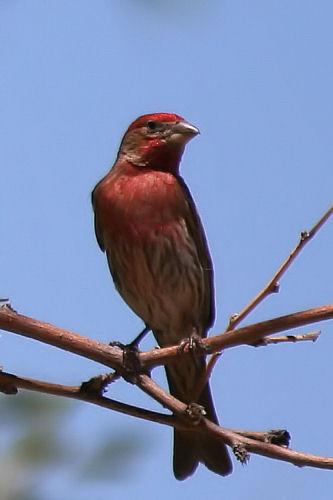
House Finches are our most frequent and numerous visitors. I've counted as many as 120 in our patio after I fill the feeders in the morning. The majority fly in and out all day long. Although they're eating us out of house and home, we do enjoy them.
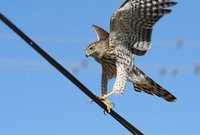
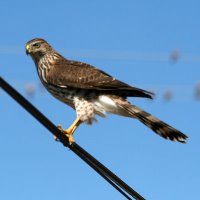
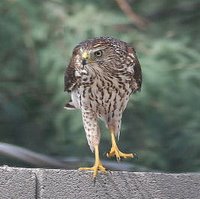
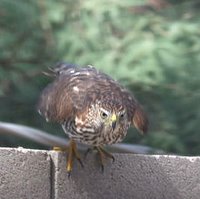
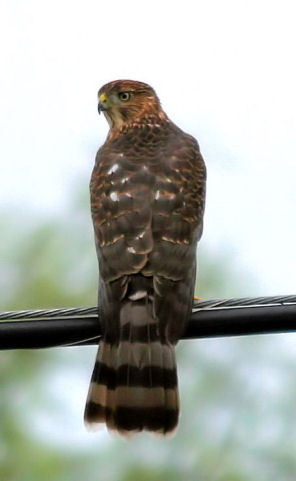
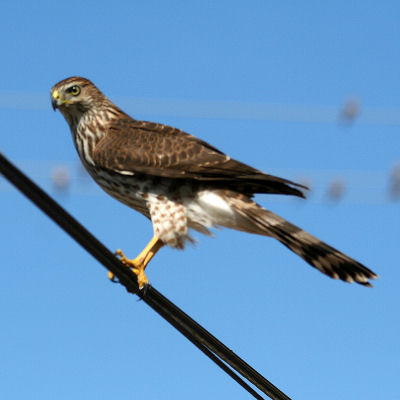
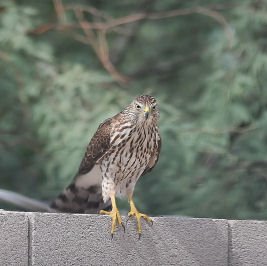
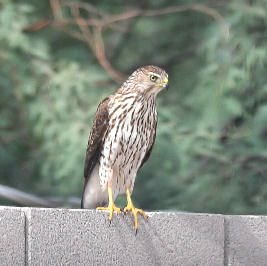
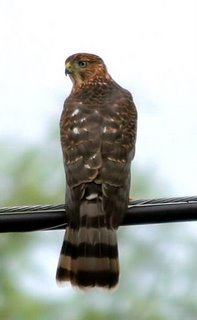
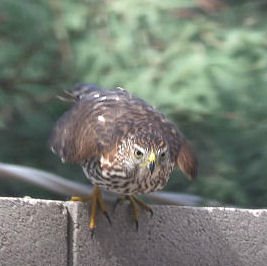
Last July, K. and I watched a hawk chasing a dove. It disappeared behind the trees. A few minutes later, all the birds at our feeders took off and disappeared. We looked out and saw this beautiful bird on the power line behind our house.It's not a hawk I've seen before and at first I thought it was a falcon. t.beth (Firefly Forest) kindly identified it for me as a juvenile Cooper's Hawk.Declines of the Cooper's Hawk in the late 1940s and 1950s were blamed on DDT and pesticide contamination. Populations started increasing in the late 1960s, but it is still listed as threatened or of special concern in a number of states. Appears to be adapting to breeding in urban areas, which may help increase populations. Project FeederWatch data indicate stable or increasing numbers over the last 15 years.A juvenile Cooper's Hawk is now a regular visitor to our neighbourhood. I usually can tell when it's nearby because I hear the flap of hundreds of wings as all the birds feeding in our patio take off instantly to seek cover.


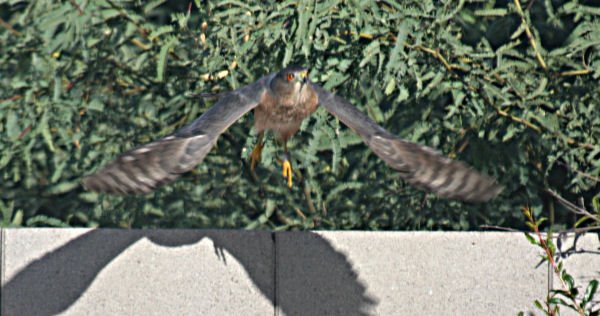
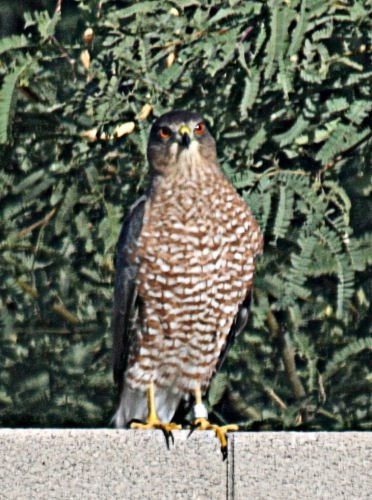
Unfortunately, I couldn't get close enough for a decent photo, but these show its fantastic red eyes and dark grey back, indicating it's an adult. (Juvenile Cooper's Hawks have brown backs and golden eyes.)
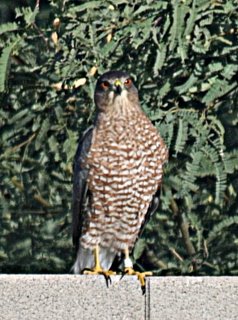
It wasn't until I processed the photo that I noticed that this hawk's been banded.
Unfortunately, I couldn't get close enough for a decent photo, but these show its fantastic red eyes and dark grey back, indicating it's an adult. (Juvenile Cooper's Hawks have brown backs and golden eyes.)
It wasn't until I processed the photo that I noticed that this hawk's been banded.
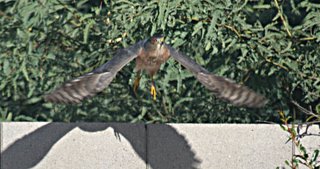
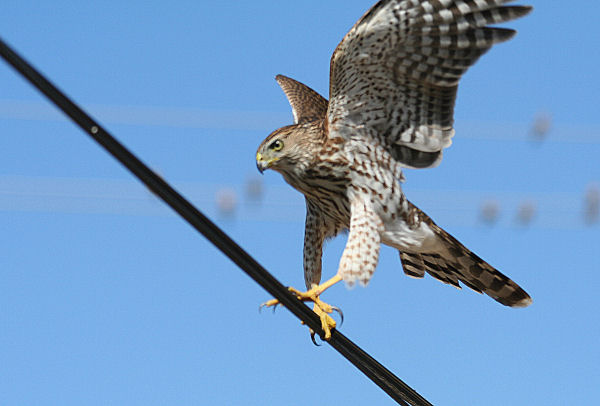
On Thursday, July 24th, K. and I watched a hawk chasing a dove. It disappeared behind the trees. A few minutes later, all the birds at our feeders took off and disappeared. We looked out and saw this beautiful bird on the power line behind our house.It's not a hawk I've seen before and at first I thought it was a falcon. t.beth (Firefly Forest) kindly identified it for me:"Your bird in the photo is a bit strange, and overall I think that it looks like a transition between an immature and adult Cooper's Hawk. Cooper's Hawks have proportionally longer tails than falcons, and your bird has quite a long tail. The one odd feature of your bird is the dark line running downward from below the eye, which is characteristic of falcons. However, Merlins and Peregrines have very dark eyes, and your bird has a yellow eye like that of an immature Cooper's Hawk. Merlins are not found in Tucson during the summer (only in the winter), but Peregrines are rare year-round residents. Cooper's Hawks are common here in Tucson, and they nest in riparian areas."On Friday morning, when it was pouring with rain, we saw the pair flying again. We watched one of the hawks land in a mesquite tree behind our property, spreading its beautifully banded wings and tail. It was a magnificent sight to see through binoculars, but not one I could photograph through the branches. However, I found a beautiful photo of a Cooper's Hawk in flight by Jim Zipp that shows just what it looked like. The pair hung out for a couple of days in the tall eucalyptus across the street.
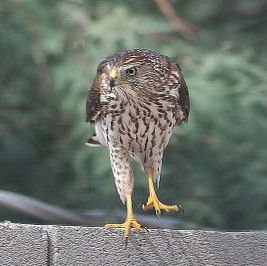
Declines of the Cooper's Hawk in the late 1940s and 1950s were blamed on DDT and pesticide contamination. Populations started increasing in the late 1960s, but it is still listed as threatened or of special concern in a number of states. Appears to be adapting to breeding in urban areas, which may help increase populations. Project FeederWatch data indicate stable or increasing numbers over the last 15 years.